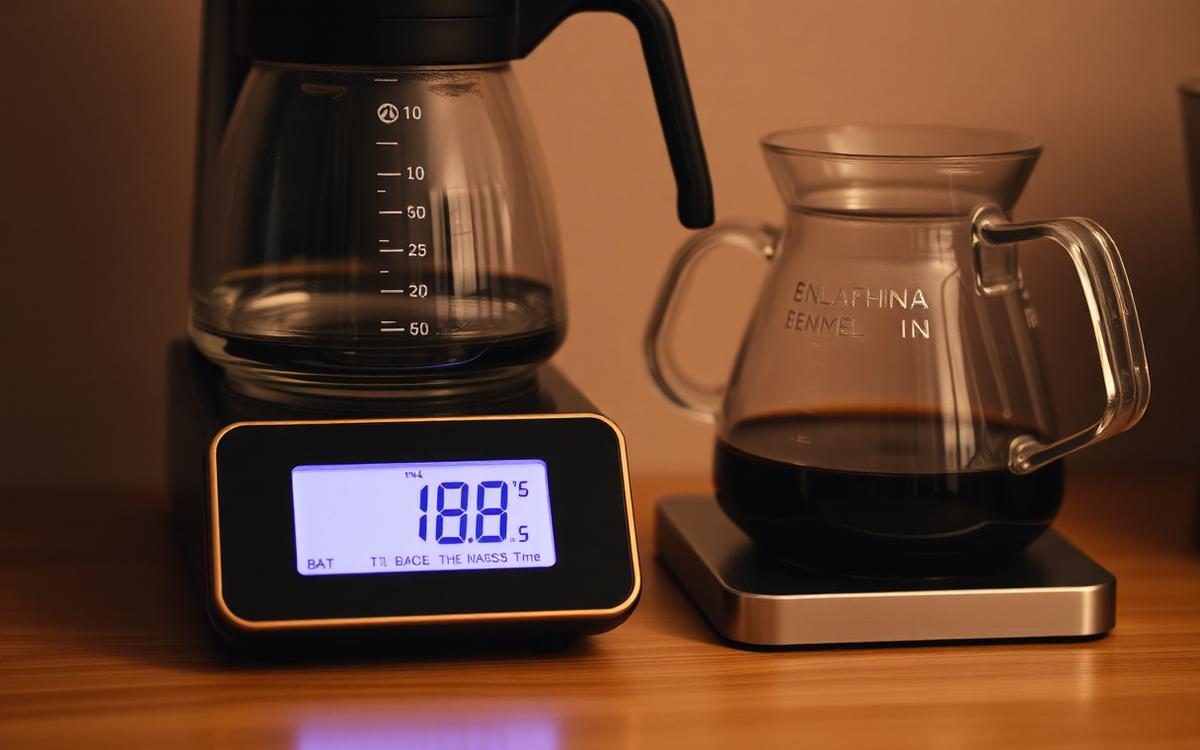
Ask ten people how much coffee they use and most will say "two scoops" or "a heaped tablespoon". Ask them why their coffee is inconsistent and they will blame the beans, the machine or the water. The real culprit is usually that they have never actually measured anything.
Volume is not a measurement of coffee
A tablespoon of coffee can weigh anywhere from 4 g to 8 g depending on grind size, roast level and how the grounds settle. Darker roasts are less dense because more moisture and mass burned off during roasting, so a scoop of dark roast holds significantly less coffee than the same scoop of light roast. Finer grinds pack more tightly than coarse ones. Change beans and your scoop silently changes your recipe by 30% or more.
Water is slightly better behaved — one millilitre is one gram, near enough — but "a mug" varies wildly and kettle markings are usually approximate.
You cannot repeat a recipe you never recorded, and you cannot record a recipe measured in scoops.
Ratios in one paragraph
A brew ratio expresses coffee to water by weight. 1:16 means one gram of coffee for every sixteen grams of water — 20 g of coffee needs 320 g of water. Filter methods live between 1:15 and 1:17, immersion around 1:15 to 1:16, espresso around 1:2, cold brew concentrate around 1:4 to 1:5. Once you think in ratios, scaling a recipe up or down is arithmetic rather than guesswork, and any recipe you read anywhere becomes directly usable.
Strength and extraction are different
This distinction unlocks everything. Extraction yield is the percentage of the coffee's mass that dissolved into the water; the accepted sweet spot is roughly 18-22%. Strength — measured as total dissolved solids — is how concentrated the resulting liquid is. Ratio primarily controls strength. Grind size, temperature, time and agitation primarily control extraction.
So a cup can be under-extracted and strong (sour and intense), well-extracted and weak (balanced but watery), or any other combination. When coffee tastes wrong, ask which of the two dials is off before touching anything. Weak but pleasant? Tighten the ratio. Sour regardless of strength? Grind finer.
What to look for in a scale
- 0.1 g resolution for espresso; 1 g is acceptable for filter but 0.1 g is more useful.
- 2 kg capacity so it handles a full carafe.
- Fast response — a laggy scale makes pouring guesswork.
- Built-in timer is convenient but a phone works fine.
- Water resistance, because it will get wet. This is what kills most kitchen scales.
A basic pocket scale from a kitchen shop does the job. Dedicated coffee scales add auto-tare, flow-rate display and better splash protection, all of which are nice and none of which are necessary.
Using it properly
- Place the whole brewing assembly — carafe, dripper, filter — on the scale and tare it.
- Add the ground coffee and note the exact dose. Do not adjust the target; record what you actually got.
- Tare again so the display reads only water.
- Start the timer with the first drop of water and pour to your target weight.
- Record dose, water, grind setting, temperature and total time.
Keeping a brew log
Five lines per brew in a notebook or phone note is enough: coffee, dose, water, grind setting, time, and one sentence on taste. Within two weeks you will have a personal database showing that a particular bean wants a finer grind than your usual, or that your grinder drifts after cleaning. This is the difference between three years of experience and one year of experience repeated three times.
Where precision genuinely stops mattering
Being precise is not the same as being fussy. Once a recipe is dialled in, a gram either way on a 320 g pour is undetectable. The scale is a tool for establishing repeatability and for diagnosing problems — not a reason to measure to two decimal places or to feel guilty about a rough Sunday morning cafetière. Weigh consistently, write it down, and then relax and drink the coffee.
Common weighing mistakes
Weighing the beans before grinding and then assuming the same weight comes out is the most frequent one: every grinder retains some coffee, so 20 g in may be 19.2 g out. Weigh after grinding when precision matters. Forgetting to tare the brewer, letting the scale auto-power-off mid-pour, and resting the kettle spout on the rim of the carafe are the other three. Finally, remember that your yield is not the same as your water: the coffee bed absorbs roughly two grams of water per gram of dry coffee, so a 20 g dose with 320 g of water leaves around 280 g in the cup. Any strength or extraction calculation has to use the liquid you actually collected, not the water you poured in.