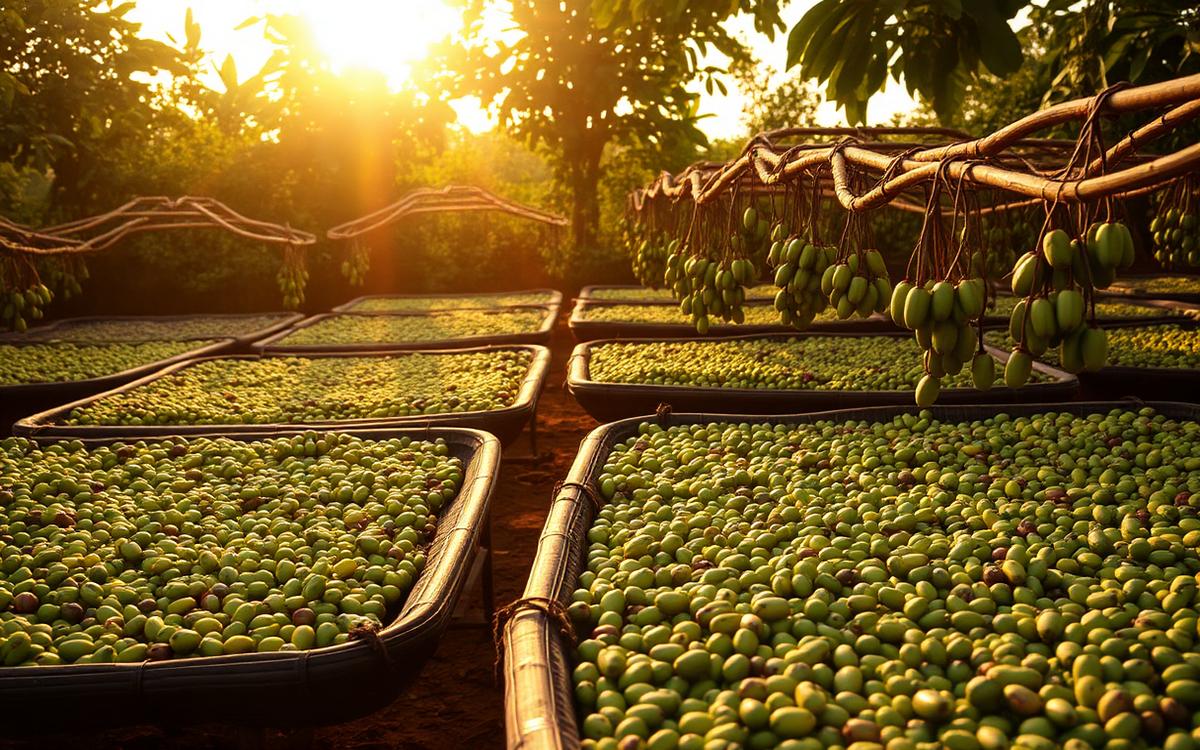
A coffee bean is the seed of a fruit. Between picking a ripe cherry and shipping a green bean, someone has to remove the skin, the sticky mucilage layer, the pulp and eventually the parchment, and dry what remains to a stable moisture content. How that is done — how fast, in what environment, and how much fruit stays in contact with the seed — leaves a permanent signature in the cup.
The anatomy of a cherry
From the outside in: skin, then sweet fruit pulp, then a slippery pectin-rich mucilage layer, then a papery parchment shell, then a thin silverskin, and finally the seed itself. The mucilage is the interesting part. It is loaded with sugars, and whether it is scrubbed off immediately or left to ferment and dry against the seed drives most of the flavour difference between processes.
Washed
Cherries are pulped mechanically within hours of picking, then fermented in water tanks for 12-72 hours until the mucilage breaks down, then washed clean and dried on patios or raised beds. Because the fruit is removed early, what remains in the cup comes from the seed itself.
The typical result is clarity, defined acidity and a clean finish. Washed coffees expose terroir and variety with very little masking, which is why competition lots from Kenya, Colombia and Ethiopia are so often washed. They are also unforgiving: a mediocre washed coffee has nowhere to hide and simply tastes plain.
Natural (dry process)
The whole cherry is dried intact, fruit and all, over two to four weeks, then hulled to release the bean. The seed sits inside a fermenting, drying fruit the entire time and absorbs a great deal of it.
Naturals taste of jam, berries, tropical fruit and often something winey or boozy. Body is heavier, acidity is lower and rounder, and the finish is sweeter. The risk is that uneven drying invites mould, over-fermentation and phenolic, medicinal off-flavours. Producing a clean natural requires constant raking and vigilance, which is why well-executed naturals command high prices while sloppy ones taste of rotten fruit.
Neither process is better. Washed shows the coffee; natural shows the fruit. Which you prefer is a preference, not a hierarchy.
Honey and pulped natural
A middle path: the skin is removed but some or all of the mucilage stays on the bean during drying. No honey is involved — the name describes the sticky texture. The categories are usually graded by how much mucilage remains and therefore how dark the drying beans appear.
- White honey: almost all mucilage removed. Close to washed with a touch more sweetness.
- Yellow honey: around a quarter retained, dried quickly in full sun.
- Red honey: most retained, dried more slowly with partial shade.
- Black honey: all mucilage retained, dried very slowly under cover. Closest to a natural.
Honey processing is a Costa Rican and Central American speciality and tends to give syrupy body with the acidity of a washed coffee — a genuinely appealing combination.
Anaerobic and experimental fermentation
Cherries or pulped beans are sealed in oxygen-free tanks, sometimes with controlled temperature, sometimes with added yeast cultures, and fermented for anywhere from 24 to 120 hours. Without oxygen, different microbes dominate and produce different acids and aromatic compounds. The results are intense and polarising: cinnamon, rum, lychee, bubblegum, tropical punch. Carbonic maceration borrows the technique directly from winemaking.
Critics argue these lots taste more of the process than the origin, and that a heavily fermented Colombian and a heavily fermented Ethiopian can be hard to tell apart. That is a fair criticism and also, for many drinkers, entirely beside the point.
Wet-hulled
Almost unique to Indonesia, particularly Sumatra. Parchment is removed at a much higher moisture content than usual and the bean finishes drying exposed. The beans take on a distinctive blue-green colour and the cup develops the earthy, herbal, cedar and tobacco character that defines Sumatran coffee. Acidity is very low and body is enormous.
Choosing by process
- Want clarity, brightness and a clean filter cup? Washed.
- Want fruit-forward intensity and sweetness, especially in a French press? Natural.
- Want body plus acidity, and a forgiving espresso? Honey.
- Want something that does not taste like coffee at all? Anaerobic.
Brew method interacts with process too. Paper filters strip some of the heaviness from naturals and sharpen their fruit; immersion emphasises their body. Trying the same natural through a V60 and a French press on the same morning is one of the more instructive experiments available.
Reading a bag label
Good roasters print the process alongside origin, variety, altitude and roast date, and that single word tells you more about what is in the cup than the region does. If a bag omits it entirely, that usually signals a commodity lot rather than a traceable one. Watch for vague marketing terms too: "special reserve" and "artisan lot" mean nothing, while "washed, 72-hour fermentation, 1,900 masl" is a genuine description you can learn from. Over time, tracking process on every bag you buy builds a far more reliable map of your own preferences than chasing famous origins ever will.