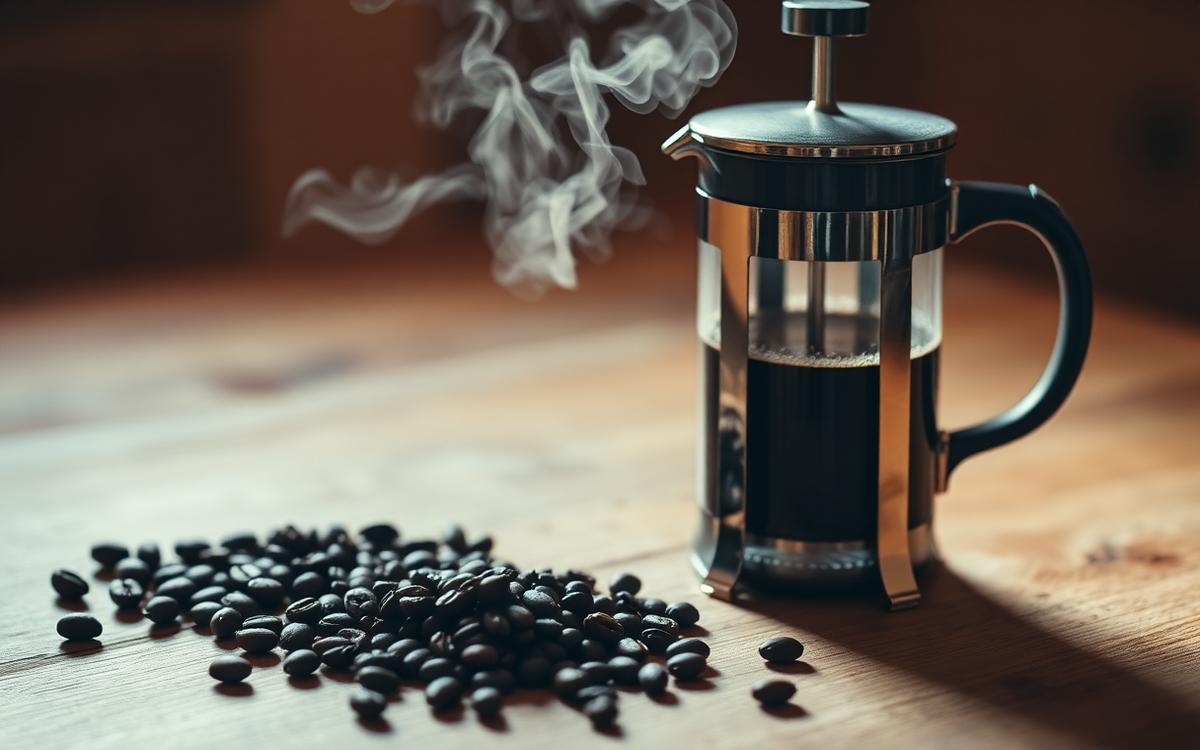
Almost everyone owns a French press, and almost everyone has decided at some point that it makes bitter, gritty coffee. That reputation is not the brewer's fault. A press is a full-immersion device with a metal filter, which means every gram of coffee sits in every gram of water for the entire brew, and nothing but a coarse mesh stands between the grounds and your cup. Those two facts dictate the whole technique. Get them right and the press produces the heaviest, sweetest, most texturally satisfying coffee available at home without an espresso machine.
Immersion behaves differently from percolation
In a pour-over, fresh water constantly washes over the bed, so extraction keeps accelerating as long as you keep pouring. In immersion, the water saturates quickly and then approaches equilibrium: as dissolved solids build up in the liquid, the rate of further extraction slows down. This is why immersion is forgiving. A pour-over left thirty seconds too long can turn harsh; a press left thirty seconds too long barely changes. It also means you cannot fix a weak brew by waiting. If the coffee tastes thin at six minutes, it will still taste thin at ten. The lever that matters is grind size and dose, not time.
Grind coarse, but not as coarse as you think
Standard advice says "coarse like sea salt", and that is a reasonable starting point. The reason is filtration rather than extraction: the mesh screen only holds back particles above roughly 200 microns, so anything finer ends up suspended in the cup as silt. Silt keeps extracting after you pour, which is exactly why the second half of a mug tastes more bitter than the first.
The compromise most home brewers land on is a coarse-medium grind with a good burr grinder. Blade grinders are the real problem here: they produce boulders and dust simultaneously, so you get under-extracted chunks and over-extracted fines in the same cup. If your press coffee is simultaneously sour and bitter, that is the signature of a wide particle distribution, not a bad recipe.
A recipe that works every time
- Ratio: 1:16 by weight — 60 g of coffee per litre, or 30 g for a two-cup 480 ml press.
- Water: 93-96 °C. Off the boil for thirty seconds is close enough.
- Pour: add all the water at once, saturating every clump.
- Wait: four minutes with the lid resting on top, plunger up.
- Break the crust: stir the floating layer gently with a spoon so the grounds sink.
- Skim: lift off the foam and any floating fines with two spoons and discard them.
- Settle: wait five more minutes. Do not plunge.
- Pour: press the plunger just below the surface and decant slowly, leaving the last centimetre behind.
Plunging is the single biggest source of sediment. Pushing the screen down forces fines back into suspension right before you pour.
Why the extra wait beats the plunge
This method is a simplified version of the technique James Hoffmann popularised, and it works because gravity is a better filter than a metal mesh. During the five-minute settle, the fines sink to the bottom and stay there. When you decant gently, the clear liquid comes off the top and the sludge stays in the brewer. The cup is noticeably cleaner and it keeps tasting the same all the way to the bottom, because there is no suspended coffee left to keep extracting.
Yes, the total process is nine minutes rather than four. Almost none of that is active time, and immersion's flat extraction curve means the extra minutes cost you nothing in flavour.
Troubleshooting by taste
- Thin and sour: grind finer or raise the dose to 1:15. Check the water was hot enough.
- Harsh and drying: grind coarser and make sure you are skimming and not plunging.
- Muddy texture: almost always fines. Coarser grind, longer settle, leave more liquid behind.
- Flat and dull: old beans, or distilled/heavily softened water with no mineral content.
What the press is genuinely good at
Because the metal filter passes coffee oils that paper traps, the press gives you body. That suits medium roasts, chocolate and nut-forward Brazils, washed Central Americans and anything you want to drink with milk. Delicate, floral, high-acid light roasts often show better through paper, where clarity matters more than weight. Pick the brewer to match the bean rather than expecting one device to flatter everything.
Keep it clean
Coffee oils go rancid. A press that smells faintly stale will make every brew taste stale, and the effect creeps up so gradually that most people never notice. Disassemble the plunger completely once a week, wash all three screen parts with detergent, and give the glass a soak in a brewer cleaner monthly. It is the cheapest quality upgrade available.