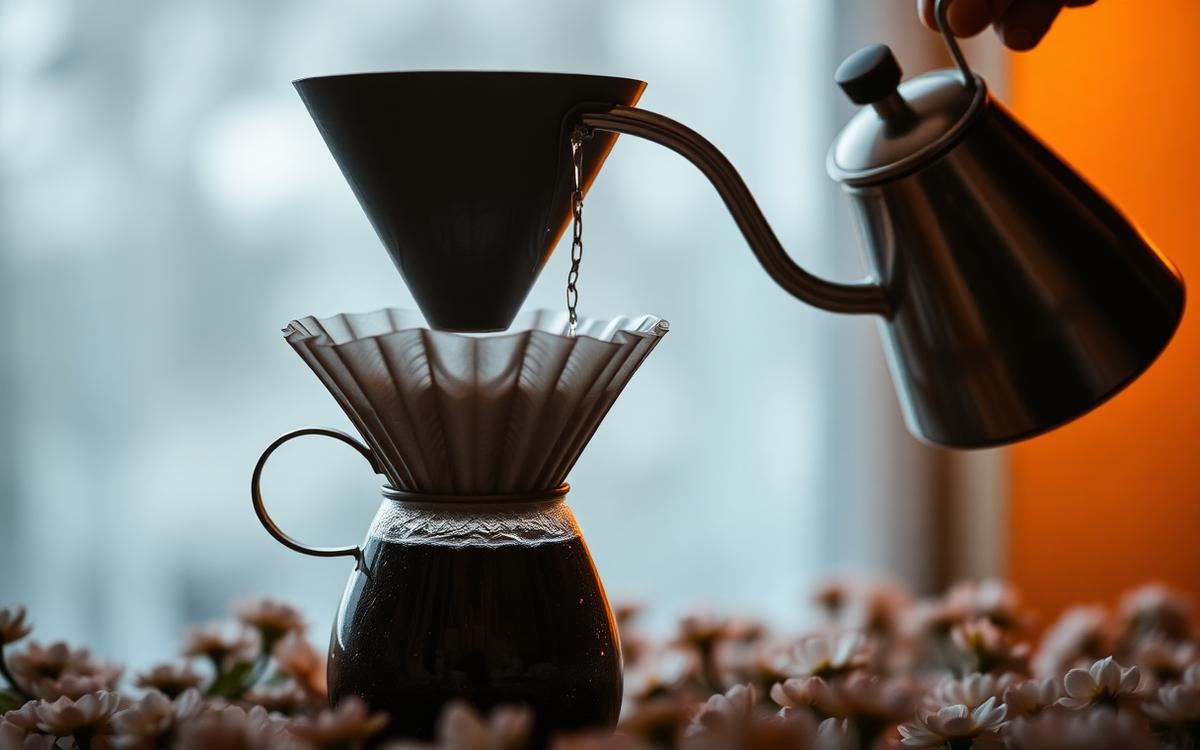
A pour-over is a percolation brew: water passes through a bed of coffee once and leaves. Unlike immersion, extraction never approaches equilibrium, so how you pour genuinely changes the result. That is what makes the method expressive and also what makes it frustrating. The fix is not a more elaborate technique — it is a schedule you can repeat without thinking, so that when the coffee tastes wrong you know exactly which single variable to move.
The three things water does
Water dissolves solubles, carries them downward, and agitates the bed. Agitation is the one most people underestimate. Pouring aggressively from a height stirs the grounds, exposes fresh surfaces and speeds extraction; pouring gently in a slow spiral extracts more evenly but more slowly. Two brewers with identical grind and ratio can land a full percentage point apart in extraction yield purely on pour energy.
A baseline recipe for a V60
- Dose: 20 g coffee, medium grind (table salt to fine sand).
- Water: 320 g total at 94 °C — a 1:16 ratio.
- Rinse: flush the paper filter with hot water and discard it. This removes papery flavour and preheats the cone.
- Bloom: 60 g of water, swirl gently, wait 40 seconds.
- Pour 2: up to 180 g in slow concentric circles.
- Pour 3: up to 320 g once the level drops halfway.
- Finish: a gentle swirl, target drawdown complete by 2:45-3:15.
Why the bloom matters
Fresh coffee is full of trapped carbon dioxide. When hot water hits it, that gas escapes as foam and physically pushes water away from the grounds, creating dry pockets and channels. Blooming with roughly twice the coffee's weight in water lets the gas out before the main pour, so the bed saturates evenly afterwards. Beans three days off roast may need a full minute; beans a month old will barely rise and forty seconds is plenty.
If your bloom does not bubble at all, the coffee is old. No recipe change will bring back what has already gassed off.
Pulse pouring versus continuous
Continuous pouring keeps the bed submerged and the temperature stable, giving a slightly heavier, rounder cup. Pulse pouring — waiting for the water level to drop between additions — increases turbulence and typically raises extraction, giving more clarity and more acidity. Neither is correct. Pick one and stay with it while you dial in the grinder, because switching between the two mid-session makes your notes worthless.
Read the bed when it is done
The spent coffee tells you what happened. A flat, level bed means water moved through evenly. A deep crater in the middle means you poured too hard into the centre. Coffee stranded high on the filter walls means you never washed it back down, so a portion of the dose contributed nothing — that is why the final swirl matters. Visible holes or gullies indicate channelling, usually from an uneven bed or an aggressive first pour.
Drawdown time is your grind gauge
For a 20 g V60 brew, a total time between 2:45 and 3:15 is a healthy window. Much faster and the grind is too coarse or the bed has channelled; much slower and the grind is too fine or fines have clogged the paper. Adjust grind first and only change ratio once the timing sits inside the window. Changing two things at once is how people spend a week and half a bag learning nothing.
Flat-bottom or cone?
Cone brewers such as the V60 concentrate the bed at the tip, giving a deeper column of coffee, faster flow at the top and a more delicate, aromatic result. Flat-bottom brewers such as the Kalita Wave or Origami keep a shallow, even bed and drain through multiple small holes, which makes them dramatically more forgiving of a sloppy pour. Beginners generally get more consistent results from a flat-bottom; the cone offers a higher ceiling once your pour is steady.
Taste, then adjust one thing
- Sour, salty, thin: under-extracted. Grind finer, raise the temperature, or agitate more.
- Bitter, dry, hollow: over-extracted. Grind coarser or pour more gently.
- Balanced but weak: extraction is fine, strength is not. Use a tighter ratio such as 1:15.
- Balanced but overpowering: loosen to 1:17.
Strength and extraction are separate dials. Ratio controls how strong the cup is; grind and technique control how much of the coffee you actually dissolved. Confusing the two is the most common reason people chase their tail for weeks.
Water and kettle notes
A gooseneck kettle is not vanity: the narrow spout lets you place water precisely and keep a slow, steady flow, which is the single biggest mechanical difference between a chaotic bed and a level one. Variable temperature control matters less than people assume — boiling water poured into a room-temperature dripper drops several degrees on contact anyway. If your kettle has no thermometer, boil and wait thirty to forty-five seconds. Beyond the kettle, brew water chemistry sets the ceiling on everything: around 70-100 ppm total hardness with modest alkalinity extracts sweetly, while heavily softened or distilled water produces coffee that tastes hollow no matter how good the technique.