A brewed cup is roughly 98.5% water and 1.5% dissolved coffee. The minerals already present in that water decide how much flavour gets extracted and how it is perceived on the palate.
Two numbers matter
- General hardness (GH): mostly magnesium and calcium. These bind to flavour compounds and pull them out of the grounds. Target roughly 50–150 ppm as CaCO₃.
- Alkalinity (KH): mostly bicarbonate. It buffers acidity — too much and the cup tastes flat and chalky; too little and bright coffees taste sharp. Target roughly 40–70 ppm.
Mineral composition can change perceived flavour. It is not a reliable one-mineral-to-one-flavour mapping.
Why mineral content is only one variable
Low-mineral water can produce a different cup, but it still extracts coffee; flavour depends on the recipe and the coffee as well as minerals. Distilled and reverse-osmosis water are excellent starting points — but when you have a measured blending plan and have checked equipment compatibility.
Practical options, cheapest first
- Filter jug: removes chlorine and some hardness. Its effect depends on the cartridge; carbon filtration and hardness reduction are different functions.
- Bottled low-mineral water: look for a bottle listing 50–150 mg/L dry residue. Consistent and requires no effort.
- Mineral concentrates: add a measured dose of magnesium and bicarbonate to distilled water. Total control, very repeatable.
- DIY recipe: Epsom salt plus baking soda in distilled water, mixed as a concentrate and dosed per litre.
Protect your machine too
Hard water scales boilers and group heads. If you own an espresso machine, low-to-moderate hardness is not just a flavour choice — maintenance should follow the machine maker’s water specification, including parameters beyond these two measurements.
One thing to try tonight
Brew the same coffee twice, once with tap water and once with low-mineral bottled water, keeping grind, ratio and time identical. The gap between the two cups is usually larger than people expect, and it costs nothing to find out.
A measurable blending example
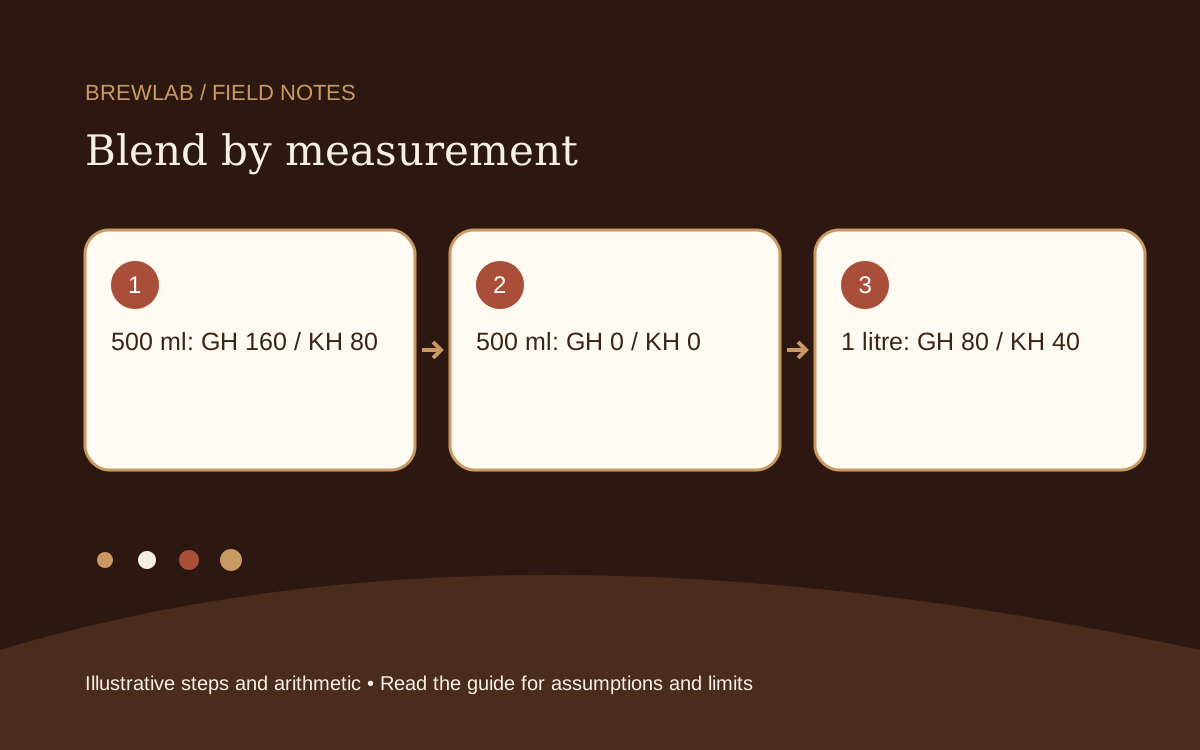
Measure both waters in the same units before blending. As a teaching example, 500 ml at GH 160/KH 80 mixed with 500 ml at GH 0/KH 0 estimates GH 80/KH 40. Use GHmix = (GH₁V₁ + GH₂V₂)/(V₁ + V₂), and the same formula for alkalinity. Remeasure the blend. These are hypothetical values, not a laboratory test or a mineral-salt recipe. Use potable ingredients and check the brewer’s water specification. Our GH 50–150/KH 40–70 comparison bands are editorial starting points, not an SCA certification.
References and scope
Hendon et al. (2014), The Role of Dissolved Cations in Coffee Extraction models ion interactions. It does not establish a universal flavour result or certify the starting bands used here.
Reviewed November 5, 2026. References support the named background topics; the comparison plans and arithmetic above are illustrative, not claimed equipment tests. Follow the instructions for your own equipment.