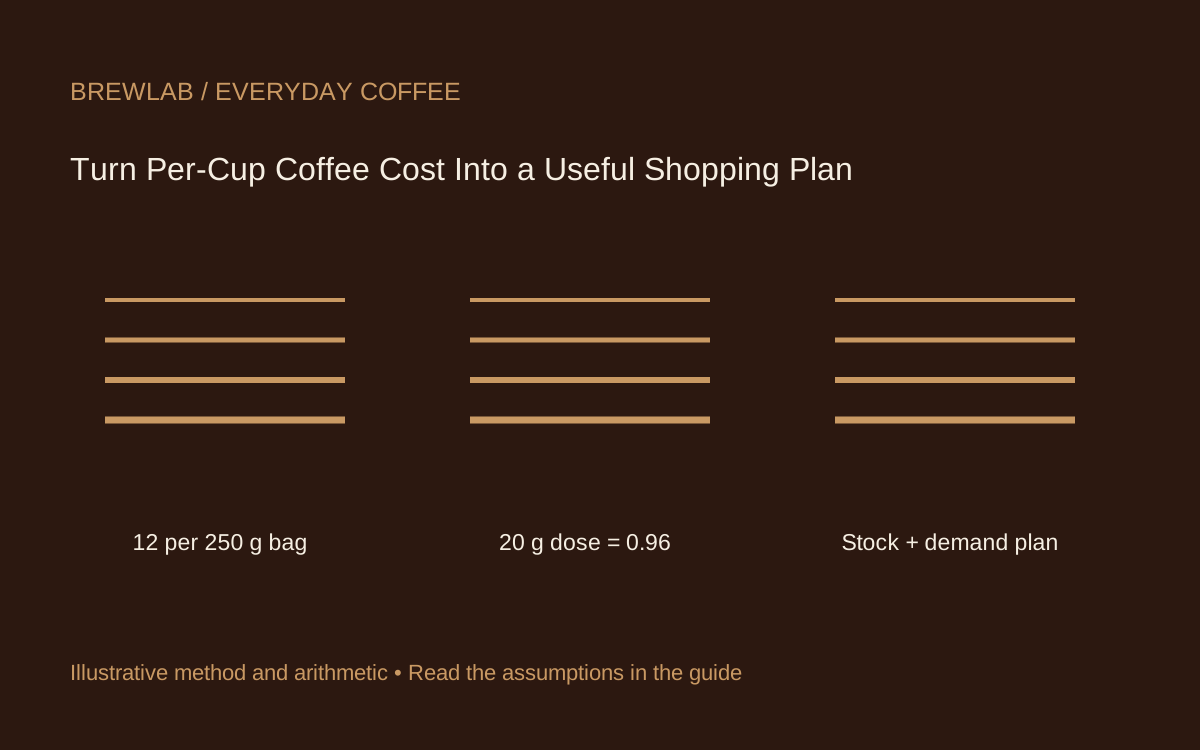
The bag price is only the beginning of a useful coffee budget. The amount used per drink, milk additions, failed attempts and the number of people sharing the supply all affect what you spend and when you run out. A simple worksheet can connect those quantities without pretending to predict future prices or tell you which coffee is worth buying.
All prices in this guide are invented teaching values in one unspecified currency. Replace them with your receipts and use the same currency throughout. No exchange rate, live retailer price or investment recommendation is involved. The goal is to make your own routine legible: identify the ingredients in one drink, estimate demand for a defined period, and compare that estimate with actual stock movement.
Choose the unit you are budgeting
Decide whether “one cup” means one brewed portion, one person’s morning mug or one finished milk drink. Write the definition next to the calculation. Otherwise, two accurate ingredient totals can still produce misleading comparisons because they divide by different numbers of servings.
Separate input coffee from beverage output. A recipe might use 18 g dry coffee and deliver 36 g espresso; the coffee purchase cost follows the 18 g dose, not the 36 g liquid. Weighed recipes published by Hario illustrate the value of explicit ingredient amounts, but a brewing recipe does not establish your actual waste or consumption. Your scale and stock record supply that information for this budget.
Calculate the coffee portion first
Suppose a 250 g bag costs 12 currency units and the recipe uses 20 g coffee. Cost per gram is 12/250 = 0.048. Multiply by the dose to obtain 0.96 per brewed portion. A 1 kg bag priced at 42 would cost 0.042 per gram, or 0.84 for the same 20 g. The arithmetic compares purchase cost per dose, not flavour, freshness or overall value.
Do not round the gram price too early. If you round 0.048 to 0.05 before multiplying, the displayed cup cost becomes 1.00 instead of 0.96. Keep reasonable precision through the calculation and round the final monetary display for your purpose. BrewLab’s cup-cost tool uses the bag mass and dose directly, avoiding a separate manually rounded intermediate price.
Add milk and other consumables separately
If milk costs 2 per litre and you use 100 ml per finished drink, the milk ingredient costs 0.20. Add that to the coffee’s 0.96, then include a hypothetical 0.10 for other consumables to obtain 1.26. Keep the components visible. If you later change the milk quantity or omit it entirely, you can update that part without guessing which costs were buried in the earlier total.
Milk poured into a jug is not always milk consumed. If the routine leaves a measured remainder, decide whether your budget counts milk prepared or milk served. For purchase planning, the amount leaving the package matters. For recipe comparison, served quantities may be more informative. Neither convention is inherently correct for every task; the important step is to name the convention and use it consistently.
Keep overhead outside the ingredient claim
A basic ingredient total normally excludes labour, equipment, energy, water treatment, delivery and repairs. Do not label it the complete economic cost of home coffee. You can add a separately defined allowance for your own planning, but it remains an assumption. Dividing an espresso machine’s purchase price by a guessed number of lifetime cups creates a scenario, not a measured depreciation rate.
Similarly, compare buying options over the same boundary. A cafe price may include service, premises and convenience that your ingredient calculation leaves out. It is reasonable to compare the cash you personally spend, provided you describe that comparison accurately. It is not reasonable to claim a business’s margin from the difference between its menu price and your bag-and-milk example.
Translate the routine into stock demand
For a bean plan, multiply cups per day by dose and then by days. Two 18 g drinks each day use 36 g daily. Over 14 days, that is 504 g. Starting with 250 g leaves an estimated purchase requirement of 254 g. The same stock covers about 6.94 days at that assumed daily rate, which is an average rather than a promise to run out at an exact hour.
Whole packages create the next practical decision. If beans are available only in 250 g bags, one additional bag would bring total available stock to 500 g, four grams below the baseline plan. A larger purchase or a changed plan would be needed.
Budget uncertainty explicitly
Create a baseline and an alternative rather than one overconfident forecast. With the example above, an additional 10 percent allowance for purge, spills or recipe experiments raises expected use from 504 g to 554.4 g. The 10 percent is an arbitrary planning assumption, not an industry waste rate. If you have measured your own losses, replace it with those records and explain how you obtained them.
You can also vary demand directly. A third 18 g drink on four days adds 72 g to the fortnight. Keeping that as a separate scenario makes its cause obvious. Do not count the extra drinks again inside a general allowance if that allowance already includes them.
Reconcile the plan with actual use
Weigh or otherwise track opening and closing stock over the same period. Opening stock plus purchases minus closing stock gives estimated beans used, provided the measurements share the same container and tare convention. Compare that amount with drinks recorded. A difference may represent purge, experiments, unrecorded portions or weighing error; it does not automatically prove waste or theft.
Repeat the exercise for a period long enough to include your normal routine. Avoid turning one unusual weekend into a permanent forecast. The worksheet should help you ask better questions about your habits, rather than produce a number that looks impressive but cannot be explained.
Order quantities you can store and use
Lower cost per gram is not useful if the larger purchase does not fit your storage habits or taste preferences. The National Coffee Association’s storage guidance discusses smaller purchases and protection from air, moisture, heat and light. That context supports checking consumption before buying a large quantity; it does not identify an exact freshness deadline for every bag in your cupboard.
Finish with a dated plan showing expected drinks, dose, opening stock, possible extra use, chosen purchase quantity and the reason for it. Link the cup-cost calculation to the bean-use planner, but keep their different purposes clear: one prices a defined serving, while the other estimates inventory needs. When the next receipt or recipe changes, update the inputs rather than treating the previous total as a permanent fact about your coffee.
References and scope
Sources checked November 5, 2026. Numerical examples are labelled teaching scenarios, not reported equipment trials. The home procedures do not claim professional certification.