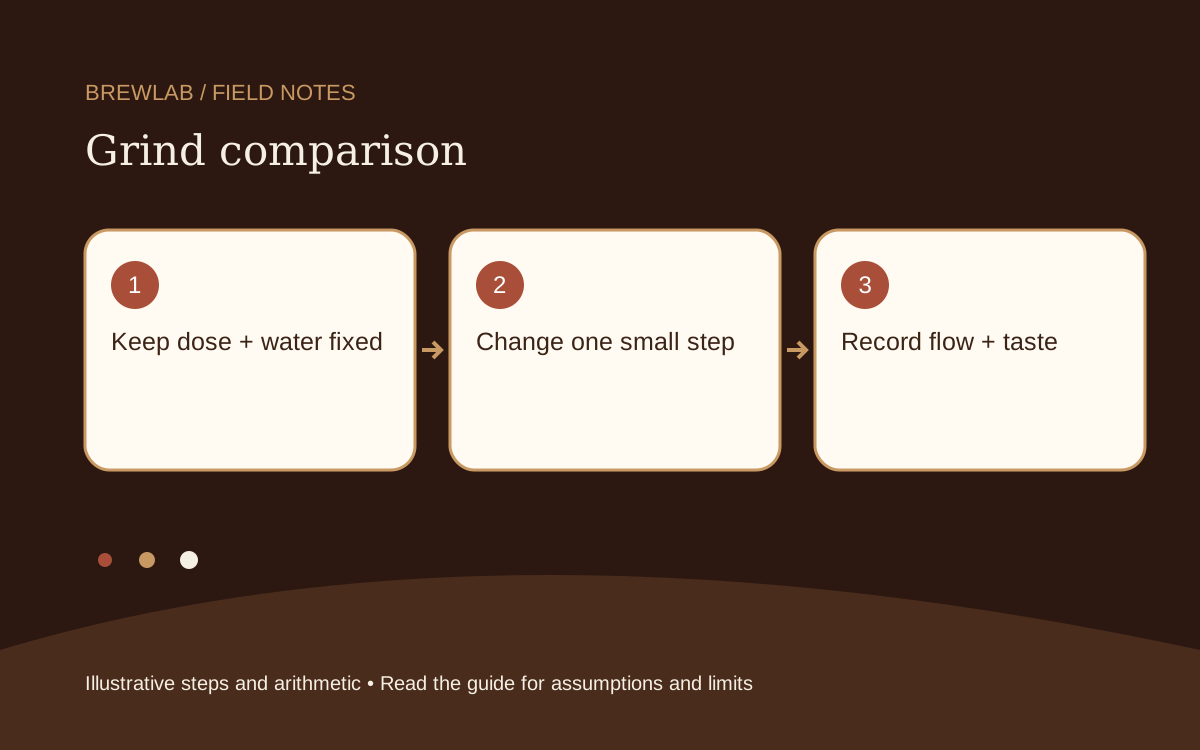
Everything you taste in a cup is soluble material pulled out of ground coffee by hot water. Grind size sets the total surface area available for that transfer, so a finer grind extracts faster and a coarser grind extracts slower. Its effect depends on the brewer, grind distribution and water flow; dose, temperature and pouring can also change the outcome.
Sour or bitter? Start with the grinder
Under-extracted coffee tastes sour, thin, salty and finishes quickly. Over-extracted coffee tastes bitter, hollow, drying and lingers unpleasantly. These are useful clues, not a diagnosis: roast flavour, water, channeling and beverage strength can produce similar impressions.
- Sour, weak, watery: grind finer, or lengthen contact time.
- Bitter, harsh, dry finish: grind coarser, or shorten contact time.
- Sour and bitter at once: check uneven extraction, distribution and grind consistency rather than assuming one cause.
Change one variable at a time, and taste after each change. Two simultaneous adjustments teach you nothing.
Rough starting points by method
- Espresso: very fine, like powdered sugar. Contact time 25–32 seconds.
- Aeropress: fine to medium-fine. 1–2 minutes.
- V60 / pour-over: medium-fine, like table salt. 2:30–3:30 total.
- Chemex: medium-coarse. 4–5 minutes.
- French press: coarse, like breadcrumbs. 4 minutes.
- Cold brew: very coarse. 12–18 hours.
Consistency beats absolute setting
Two grinders never share a number. What matters is that your grinder produces a narrow distribution of particle sizes. A broad particle distribution can affect extraction and flow, but fines do not inevitably make a bitter cup and particle size alone does not establish taste. A conical or flat burr grinder with sharp burrs is the single upgrade that improves every method you own.
A practical adjustment routine
- Fix your ratio and water temperature; keep them constant.
- Brew, then note total draw-down or brew time.
- Taste and label the cup: sour, balanced or bitter.
- Move the grinder one or two clicks in the indicated direction.
- Repeat until the cup is sweet and the finish is clean.
Stop when the comparison gives a useful direction; the number of brews needed varies. Write the setting down — it will drift as beans age, but you will have a starting point instead of guesswork.
Make a two-brew decision
Keep dose at 20 g and water at 320 g. Record the grinder model, setting, total drawdown and one taste observation. Change only one small grinder step for brew B. If it tastes sweeter without an unpleasant finish, keep that direction; if both cups are harsh, check water and preparation before making another grind change. The reference chart gives categories, not transferable click numbers.
References and scope
Reviewed November 5, 2026. References support the named background topics; the comparison plans and arithmetic above are illustrative, not claimed equipment tests. Follow the instructions for your own equipment.