A cup can feel intense without being well balanced, and a balanced cup can still feel too concentrated. Calling both problems “strong coffee” hides the decision you need to make. One decision changes the concentration of coffee already in your cup. The other changes how you prepare the next dose. Keeping those decisions separate saves you from adjusting a grinder when a little measured water would answer the immediate question.
This guide uses hypothetical measurements to show the arithmetic. They are not results from a tasting trial, and they do not establish the best extraction for your beans. You can reproduce the calculations with BrewLab’s extraction and measured-strength dilution tools. Without a suitable instrument, the same distinction still helps: describe whether you dislike the drink’s intensity, its flavour balance, or both before changing the recipe.
Start with three quantities
Dry dose is the mass of coffee used before brewing. Beverage mass is the liquid collected, not the water you poured into the brewer. Percent total dissolved solids, or TDS, describes the concentration of dissolved material in that beverage. VST’s coffee refractometer specifications explicitly report the measurement as percent TDS. A reading of 1.35 means 1.35 percent, not a decimal fraction of 0.0135 entered into a field labelled percent.
In the simple beverage-based calculation, dissolved coffee mass equals beverage mass multiplied by TDS divided by 100. Divide that dissolved mass by dry dose and multiply by 100 to express extraction as a percentage. The two factors of 100 cancel, leaving EY percent = TDS percent × beverage mass / dose. The units are part of the formula, not optional decoration.
Work the cup, not just the percentage
Imagine 18 g dry coffee produces 250 g beverage at 1.35 percent TDS. The beverage contains an estimated 3.375 g dissolved material: 250 × 0.0135. Relative to the 18 g dose, that is 18.75 percent. Now imagine another beverage from an 18 g dose with 200 g collected at 1.60 percent TDS. Its dissolved mass is 3.2 g, giving about 17.78 percent beverage-based extraction.
The second drink is more concentrated but has a lower calculated extraction. Neither number tells us which tastes better. The example simply disproves the idea that a higher TDS reading always means more of the dry dose dissolved. To compare recipes intelligently, keep the dose, collected mass and TDS together in the same notebook row. Recording only one percentage removes information you need later.
Dilution changes strength without rebrewing
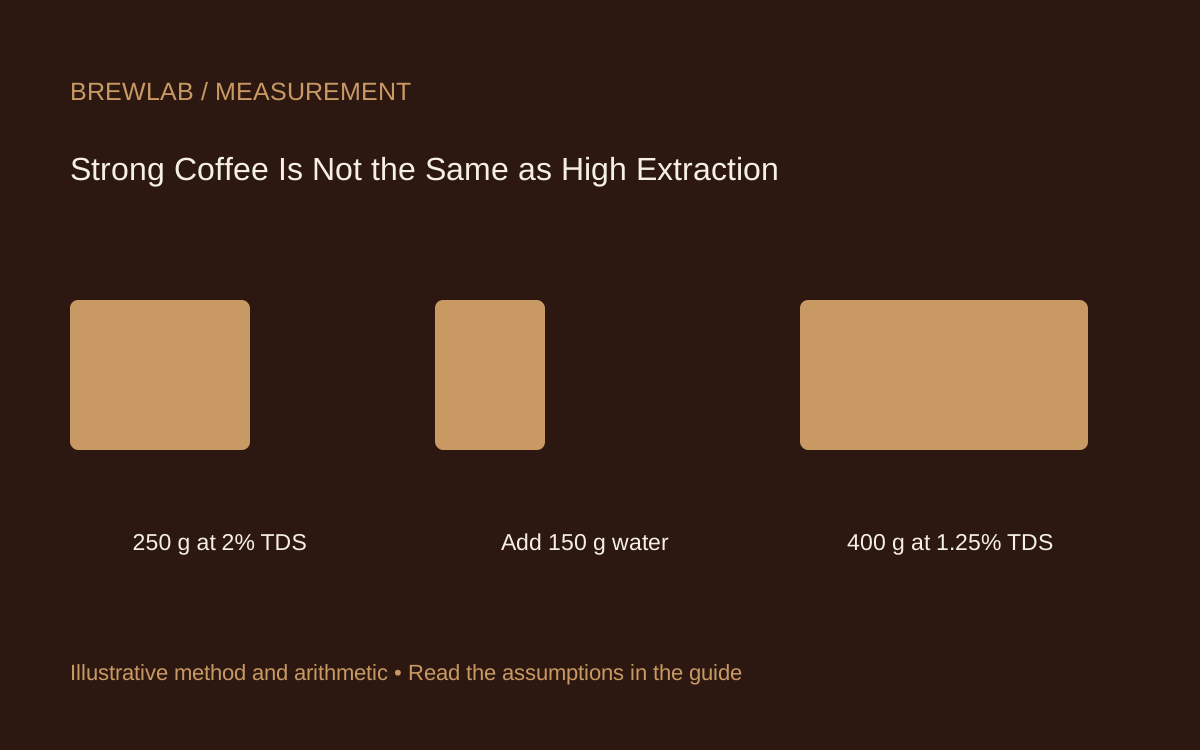
Take a different hypothetical cup: 250 g beverage at 2 percent TDS. It contains 5 g dissolved coffee material. Add 150 g water with negligible coffee solids, and the final mass becomes 400 g. Those same 5 g now represent 1.25 percent of the drink. The dissolved coffee did not return to the grounds or undergo a second extraction; it is simply distributed through more liquid.
The useful equation is final beverage mass = initial beverage mass × initial TDS / target TDS. Subtract the initial mass to find the water addition. This is why the measured-strength tool asks for actual TDS, while the cold-brew recipe-ratio tool offers only a rough proxy. An input coffee-to-water ratio does not measure the concentrate you recovered after filtration.
Choose the next action deliberately
If a coffee tastes pleasant but overwhelming, compare a small diluted portion with an undiluted portion before remaking the entire recipe. Weigh both portions and their additions. If dilution makes it easier to enjoy, you have learned something about serving strength. If an unpleasant flavour persists, dilution has not established its cause. Roast character, uneven preparation, water composition and measurement quality remain possible influences.
For the next brew, make one intentional comparison. Keep a written baseline and change either the brewing conditions or the serving dilution, rather than changing several variables invisibly. There is no requirement to force every coffee into one numerical band. A reference band can organize observations, but it cannot taste the beverage or diagnose a fault from a single reading.
Treat instrument readings as measurements
A refractometer infers concentration through an optical measurement and a calibration model. Follow the instructions for your coffee-specific instrument, including sample preparation, cleaning and temperature conditions. Do not assume a water conductivity pen reports the same quantity. Do not copy a Brix reading into a percent coffee TDS field without an appropriate validated conversion for that instrument and sample.
Repeatability is worth checking before chasing tiny differences. Prepare a sample consistently, repeat the reading as instructed, and note disagreement instead of selecting the value closest to your expectation. VST publishes instrument-specific accuracy and operating limits; those specifications are a reminder that extra decimal places are not unlimited certainty. Other instruments have different specifications and should be treated on their own terms.
Recognize what the model leaves behind
The beverage-based calculation counts dissolved material in the liquid collected. It does not directly account for liquid retained in an immersion bed, nor describe extraction uniformity across particles. Two cups can share a total while differing in how that material was extracted. Suspended material, sample preparation and the brewing water also complicate interpretation. Treat the output as a clearly defined estimate rather than a complete physical audit.
Water chemistry deserves separate attention. Hendon and colleagues studied interactions between dissolved cations and selected coffee compounds using a computational approach. That research provides chemical context; it does not justify assigning a guaranteed taste or extraction result to every household water recipe. Keep the arithmetic of a measured cup distinct from broader claims about why it tasted that way.
A useful record for the next session
Use columns for coffee identity, dry dose, brew water, collected beverage, sample procedure, TDS, calculated extraction and taste notes. Add any serving water as a separate entry. If you dilute after measurement, either retain the original figures together or calculate the new concentration using the final mass. Do not combine the original TDS with a diluted beverage mass: that silently invents extra dissolved coffee.
Before concluding that extraction improved, ask what actually changed and what remained unmeasured. A sweeter result may be worth keeping even when the number moves unexpectedly. A repeatable recipe plus an honest description is more useful than a precise-looking percentage detached from its inputs. The practical goal is to know whether you are adjusting the cup’s concentration or investigating the preparation of the next one.
A quick consistency check is to estimate dissolved mass before accepting a surprising output. If your entries imply more dissolved coffee than the entire dry dose, check the dose, beverage mass and percent convention first. Such a result is a measurement or entry question, not evidence of an exceptionally successful brew.
References and scope
- VST coffee refractometer specifications: percent TDS and instrument limits
- Hendon et al.: chemical context, not a universal taste prescription
Sources checked November 5, 2026. Numerical examples are labelled teaching scenarios, not reported equipment trials. The home procedures do not claim professional certification.