Mixing two waters is straightforward arithmetic once the measurements are compatible. Choosing a useful mixture requires more care. A bottle label may report calcium ions, a test kit may report hardness as calcium carbonate equivalent, and a handheld meter may report an estimate of total dissolved solids. Those numbers cannot simply be placed in the same column and averaged as if they described the same property.
Start with potable water sources and current information about each. This guide calculates a hypothetical blend; it does not establish drinking-water safety, prescribe a mineral supplement, or override an espresso-machine specification. The contribution here is a repeatable way to solve the proportion, discover incompatible targets and check your result. BrewLab’s two-source blending tool performs the weighted averages once the source readings are ready.
Build a source worksheet first
Make a small table with one row per water. Record total hardness, alkalinity, the reporting units, the measurement date and whether the value came from a test, supplier report or label. Include the name of the test method when available. If you cannot establish what a number means, leave it unknown rather than turning it into a confident zero. Missing magnesium information, for example, does not mean magnesium is absent.
USGS describes hardness primarily through dissolved calcium and magnesium. Calcium hardness and total hardness therefore need different labels. The units “as CaCO3” express an equivalent reporting basis; they do not mean that every dissolved constituent is literally present as calcium carbonate. Our mineral-hardness tool converts calcium and magnesium concentrations to approximate equivalents, but it does not supply missing alkalinity data.
Calculate the weighted average
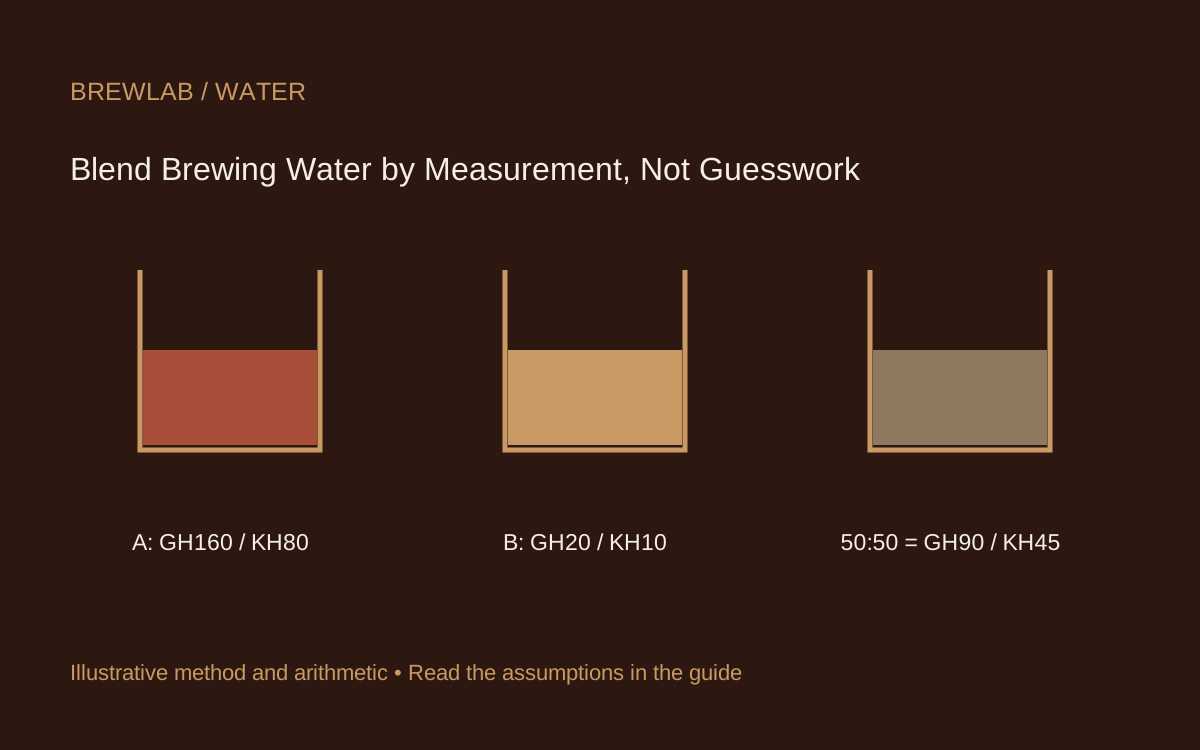
Suppose water A measures GH 160 and alkalinity 80, both in ppm as CaCO3. Water B measures GH 20 and alkalinity 10 in the same units. For a mixture containing fraction f of A, blended GH = 160f + 20(1 − f). Blended alkalinity = 80f + 10(1 − f). The fraction is between zero and one; 0.5 means equal volumes.
For a one-litre batch at 50 percent A, measure 500 ml of each source. The predicted GH is 90, and predicted alkalinity is 45. These values are teaching inputs, not a recommendation for every brewer. The simple model assumes additive volumes and no change in dissolved composition through precipitation or other reactions. It is an estimate you should verify, not a replacement for testing.
Solve backward from one target
If the desired GH is 80, solve f = (80 − 20)/(160 − 20), giving approximately 0.4286. A one-litre mixture therefore uses about 428.6 ml A and 571.4 ml B. Substitute that fraction into the alkalinity equation: 80 × 0.4286 + 10 × 0.5714 gives approximately 40. The two target properties happen to align for these particular source values.
You do not need four decimal places of measuring precision to learn from the example. Rounding to 430 ml and 570 ml predicts GH 80.2 and alkalinity 40.1. Whether that difference matters depends on the reliability of the original measurements and the purpose of the blend. Display precision should not distract from larger uncertainty in a supplier report or a drop-count test.
Discover an impossible combination early
Now ask for GH 80 and alkalinity 50 from those same two waters. GH 80 still requires fraction 0.4286, which predicts alkalinity 40, not 50. Alkalinity 50 instead requires fraction (50 − 10)/(80 − 10), approximately 0.5714. That mixture predicts GH 100. There is no single proportion that reaches both requested targets under the stated model.
This is not a calculator fault. Two source waters provide one adjustable proportion, so their possible mixtures form a limited set of combinations. A target outside the range between both sources is also impossible by blending alone. Identify which property actually matters for your equipment or comparison, reconsider the target, or investigate a different documented water source. Do not keep tweaking volumes while expecting independent control of both readings.
Mix a small, labelled batch
Use a clean container suitable for drinking water. Label it with the sources, volumes and date so it cannot be confused with a concentrate or cleaning solution. Mix thoroughly before taking a sample. A small trial limits waste and makes it easier to repeat the same process. Keep preparation separate from chemical cleaning products and do not improvise mineral additions from materials not intended for food use.
Check the resulting GH and alkalinity with the same reporting basis used for the inputs. If the result differs substantially, revisit the source values, test resolution, measured volumes and container history. Retest before changing the recipe. Arithmetic can be internally correct while the real input measurements are wrong, old or taken from water after a treatment device whose performance has changed.
Compare flavour without making a safety claim
To examine taste, brew the same coffee using your normal water and the trial blend while keeping the recipe constant. Record water identity separately from the cup code if you want to taste without seeing the labels. Differences in flavour are observations about that comparison. They do not prove that one mixture is universally ideal or safe for every espresso boiler, kettle or household supply.
Mineral composition involves more than GH and alkalinity. Hendon and colleagues’ work on dissolved cations helps explain why individual ions deserve attention, but their model is not a household certification test. Do not infer pH, chloride concentration or equipment compatibility from two averaged numbers. For a machine, check its current water requirements and maintenance instructions before introducing a changed blend.
Keep a recipe that another person can reproduce
Your final record should show both source names, their measured values and units, the fraction or volumes used, predicted results, measured results and any equipment restrictions checked. Include what you did when a target was infeasible. This is more informative than a label saying “coffee water,” because another person can reconstruct the reasoning and detect when a source has changed.
Revisit the recipe when the source water, cartridge, supplier information or testing method changes. The earlier blend is a dated procedure, not a permanent property of a brand or tap. Once you can identify the quantities and verify the result, the blending tool becomes a useful shortcut. Until then, an unfilled measurement is a question to resolve rather than an invitation to guess.
A practical stop rule is to pause whenever the units, source identity or equipment requirements remain unresolved. Buying another test or requesting a supplier report may be more useful than producing a larger batch. The correct answer can be that the available information does not yet support a blend.
References and scope
Sources checked November 5, 2026. Numerical examples are labelled teaching scenarios, not reported equipment trials. The home procedures do not claim professional certification.